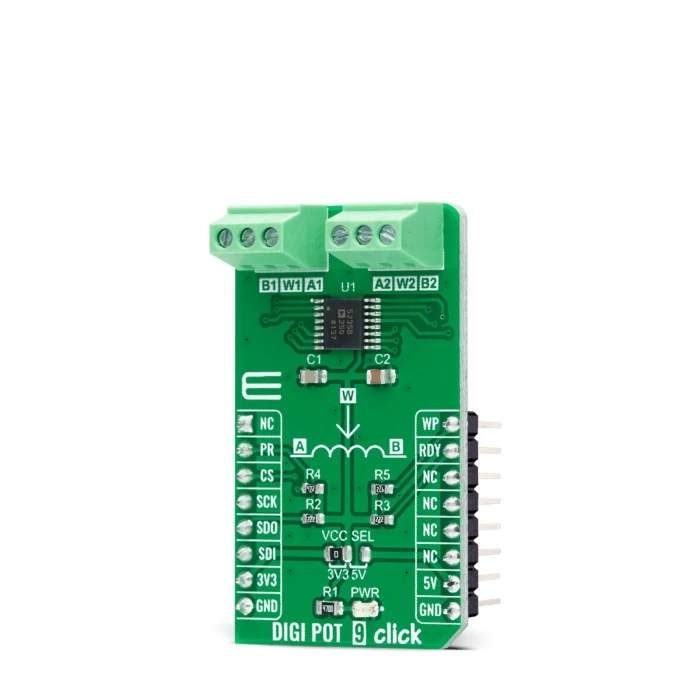
DIGI POT 9 Click is a compact add-on board used as a digitally controlled potentiometer. This board features the AD5235, a dual-channel, nonvolatile memory, digitally controlled potentiometer from Analog Devices. The AD5235’s versatile programming via an SPI-compatible serial interface allows multiple modes of operation and adjustment. The resistor wiper position is determined by the RDAC register contents, which act as a scratchpad register, allowing unlimited changes of resistance settings. The nominal resistance of the RDAC between terminal A and terminal B (RAB) is 250 kΩ with 1024 positions (10-bit resolution). This Click board™ can be used as mechanical potentiometer replacements, voltage-to-current conversions, gain and offset adjustment, and many other applications.
DIGI POT 9 Click is supported by a mikroSDK compliant library, which includes functions that simplify software development.
DIGI POT 9 Click as its foundation uses the AD5235, a digital potentiometer that operates as a proper variable resistor from Analog Devices. The resistor wiper position is determined by the RDAC register contents, that act as a scratchpad register, allowing unlimited changes of resistance settings. The scratchpad register can be programmed with any position setting using the standard SPI serial interface by loading the 24-bit>
This Click board™ communicates with MCU through a standard SPI interface and operates at clock rates up to 10MHz, supporting the two most common SPI modes, SPI Mode 0 and 3. In the format of the>
An additional feature of this board represents optional write-protect and hardware override preset signals, routed to the PWM and RST pins of the mikroBUS™ socket, and labeled as WP and PR. Hardware override preset feature refreshes the scratchpad register with the current contents of the EEMEM register. Factory default loads midscale until EEMEM is loaded with a new user-set value. On the other hand, the write-protect signal disables any changes to the scratchpad register contents, except for the EEMEM setting. Therefore, write-protect can be used to provide a hardware EEMEM protection feature. Also, it uses a ready RDY pin, routed to the INT pin of the mikroBUS™ socket, used for EEMEM instruction completion indication.
This Click board™ can operate with both 3.3V and 5V logic voltage levels selected via the VCC SEL jumper. This way, it is allowed for both 3.3V and 5V capable MCUs to use the communication lines properly. However, the Click board™ comes equipped with a library that contains easy-to-use functions and an example code that can be used, as a reference, for further development.